
Bee Rules
Rule Purpose
A rule can behave like a procedure, a function, a constructor, a method or a class. These are concepts used in other languages. Bee has simplified the concept under one single entity called "rule". Because a rule has it's own states, it can be instantiated and can be used to create "objects". Due to this versatility of rules, learning rule syntax is essential for understanding how to create and manage Bee code.
Rule Anatomy
A rule is a block of code that start with keyword: "rule" and end with keyword "return". You can send arguments to a rule when you apply the rule. After one rule execute you can capture results into variables using assign statement or output parameters.
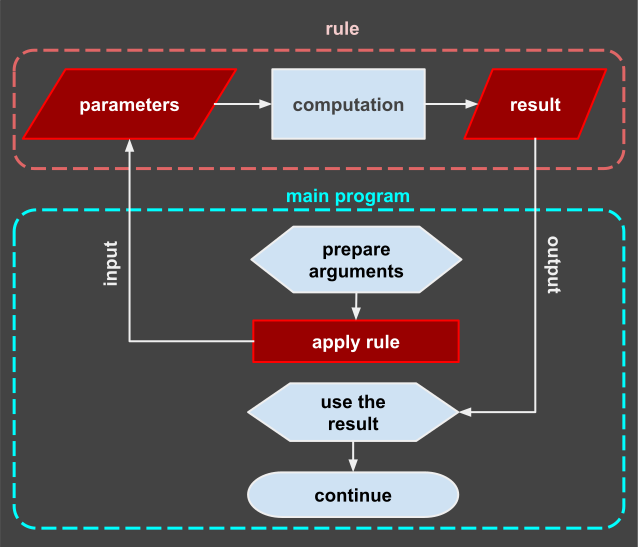
Rule Concept
We have chosen "rule" keyword instead of "def" for naming a sub-program. Rules can have side-effects similar to procedures, methods or subroutines in other languages. Let's review what we have learned so far:
Review:
- A rule start with keyword: rule;
- A rule ends with keyword return;
- A rule can have public/private states;
- A rule can have parameters and results;
Rule Features
We have learned that Bee rules can take different roles depending of how is defined. One rule have a name, parameters and result. Next we explain how to define these features to create rules and apply rules:
Rule parameters
Parameters are special variables defined in rule signature using parenthesis. The parameter list is used to define input arguments. Each parameter is a local variable, it has a name, a type and initial value.
Example:
In next example we define a rule that require two string parameters. We provide arguments for each parameters by position. In this case, foo do not return results so we use "apply" keyword to execute the rule. Second parameter is a string.
-- a rule with two parameter
rule foo(name ∈ S, message ∈ S):
    let message:= "hello:" + name + ". I am Foo. Nice to meet you!";
return;

-- using apply + rule name will execute the rule
rule main:
    new str ∈ S;
    apply foo("Bee", str);
    print str;
return;
Expected output:
hello: Bee. I am Foo. Nice to meet you!
Notes:
- Parameters are enumerated in a list separated by comma;
- Optional parameters are initialized using ":";
- Primitive types parameters receive values: by copy;
- Composite type parameters receive value: by share;
Rule results
A rule can have multiple results. Result variables must be declared. This is characteristic to Bee language. In other languages, you can use: "return value" but in Bee things are different. A rule has a result list similar to a parameter list.
Example:
In this example we have a rule that return a tuple of two values. These values can be assigned inside the rule body. If the values are not assigned the default values are used. Like parameters, the result variables can have initial values.
-- rule with two results "s" and "d"
-- parameter x is mandatory y is optional
rule com(x ∈ Z, y: 0 ∈ Z) => (s, d ∈ Z):
    let s := x + y;
    let d := x - y;
return;

rule main:
    -- capture result into a single variable
    new r := com(3,2); -- create a list
    print r; -- (5,1)

    -- deconstruction of result into variables: s, d
    new s, d := com(3, 2);                       -- capture two values
    print(s, d)(sep: ",");                       -- 5,1 (Decision 6 curried named-argument form)

    -- ignore second result using variable "_"
    new a, _ := com(3);
    print a; -- 3
return;
Notes:
- Multiple results are declared with name and can also have initial value;
- Spread a collection into arguments with * (e.g. apply foo(*args););
- Collect the trailing results into a collection by prefixing the last target with * (e.g. new head, *tail := multi(););
- You can capture results into multiple variables separated by comma;
- You can ignore one result using anonymous variable "_";
- Rules with multiple results can not be used in expressions;
Curried Signatures & Named Parameters
Since Decision 6 (2026-09-12), a Bee rule may declare an optional second parameter list — the named-parameter slot — directly after the primary parameter list. The slot accepts its arguments by name at the call site via a second parenthesised argument list. This gives rule invocations a clean, self-documenting keyword-argument style and replaces the legacy using postfix on print / write directives.
Signature & Call Pattern
-- canonical named-slot rule (declared by the system library)
rule print(*items ∈ [@]) (sep: ", " ∈ S, end: "." ∈ S):

return;

-- canonical call sites
print(10, 20, 30)                     (sep: " | ");         -- primary list only, sep defaults used
print(s, d)                          (sep: ",", end: "");   -- all named arguments supplied
print("a", "b")                      ();                   -- empty named slot: all defaults
Rules of the Named Slot
- The two parameter lists are independent binders: positional arguments never flow into the named slot and named arguments never flow into the primary list.
- Named arguments are order-independent: (end: ";", sep: " | ") and (sep: " | ", end: ";") resolve identically.
- Parameters in the named slot may declare defaults using :; omitted names fall back to those defaults.
- The named slot is reserved at compile time: a rule may declare an empty slot rule ping()(): and still receive an empty curried call ping()().
- The named slot does not support the * variadic prefix.
Variadic Rule
The last parameter in a parameter list can use prefix: "*" to receive multiple values into an array of values. This is called "varargs" parameter and is very useful way to accept multiple parameters by declaring just one.
-- rule with varargs
rule foo(*bar ∈ [Z]) => (x ∈ Z):
    new c := bar.count();
    -- precondition
    if (c = 0) do
        let x := 0;
        exit;
    done;
    -- sum all parameters
    for ∀ i ∈ (0.!c) do
        let x += bar[i];
    done;
return;
-- we can call foo with variable number of arguments
rule main:
    print foo();        -- 0
    print foo(1);       -- 1
    print foo(1,2);     -- 3
    print foo(1,2,3);   -- 6
    print foo(1,2,3,4); -- 10
return;
Early Termination
A rule should have a single exit point. Therefore in Bee the last statement in a rule is "return". The return is closing the rule block. However a rule can have an one or many other termination points. A function can be interrupted using keyword "exit" that terminate the rule without signaling any error. Other way to terminate a rule is to create an exception. This will be explained later.
Pattern:
-- define a functional rule
rule name(param ∈ type,...) => result ∈ type:
    ...
    exit if condition; -- early (successful) transfer
    ...
    let result := expression; -- computing the result
    ...
return;

rule main:
    -- direct call and print the result
    print rule_name(argument,...);

    -- capture rule result into a new variable:
    new r := rule_name(argument,...);

    -- using existing variable:
    new n ∈ type;
    let n := rule_name(argument,...)
return;
Rule Contracts
Bee rules support Design by Contract. A contract is a formal check embedded in the rule body that verifies the rule is called correctly and computes correct results. Two keywords are available: assert and expect.
Example:
In next example we define a rule that divides two real numbers. The precondition guards against division by zero. The postcondition verifies the result satisfies the division invariant.
-- a rule with contracts
rule divide(a ∈ R, b ∈ R) => (ratio ∈ R):
    assert b ¬ 0;           -- precondition: warn if divisor is zero
    let ratio := a / b;
    expect ratio * b ≈ a; -- postcondition: halt if invariant fails
return;
Semantics:
- assert condition; — Precondition check. If the condition is false (0 or false), a warning W0301: AssertionWarning is printed to standard error (stderr), but program execution continues uninterrupted.
- expect condition; — Invariant check. If the condition is false, a runtime error E0303: ExpectationFailed is raised and propagated up the call stack. If it is not caught by an enclosing trial block, the application halts immediately with a failure exit status.
Notes:
- Place assert statements first in the rule body: they verify inputs before computation;
- Place expect statements last, before return: they verify results before handing them back;
- Contracts are regular statements, not part of the rule signature — you can use them in any rule, including main;
- Use the approximate comparison operator ≈ instead of = when checking real number results;
Advanced Topics
Next features will be explained later in more details after we learn more elements required for advanced examples. Making examples for these features require knowledge about collections and data processing. So you can read a brief introduction now then skip ahead.
Forward declarations
Hoisting is a technique used by many modern compilers to identify declarations of members. Using this technique you can use an identifier before it is defined. In Bee there is no hoisting technique. You can not use an identifier before it is declared or loaded.
To be able to create a faster compiler we use a retro design. In Bee the main rule is defined at the bottom of the main module. Private rules must be defined first. Public rules are defined last in the module.
Two rules may call each other and create a cyclic interdependence. For this special case you can declare a rule "signature" before implementing it. That is called "forward declaration". Most modules do not need forward declarations.
Pattern:
-- forward declaration pattern
rule plus(a, b ∈ Z) => (r ∈ Z); -- forward declaration

-- declare the main rule
rule main:
   -- execute before implementation
   print plus(1,1);
return

-- later implement the rule "plus"
rule plus(a,b ∈ Z) => (r ∈ Z):
  let r := (a + b);
return;
Recursive Rules
Example1
Regular recursive rule can not be optimized by the compiler.
-- this rule is not optimized:
rule fact(n ∈ N) => (r ∈ N):
    when (n = 0) do
        let r := 1;
    else
        let r := n * fact(n-1);
    done;
return;
Tail Call Optimization
Normally during recursion, the runtime needs to keep track of all the recursive calls, so that when one returns it can resume at the previous call and so on. Keeping track of all the calls takes up space, which gets significant when the function calls itself a lot. But with TCO, it can just say "go back to the beginning, only this time change the parameter values to these new ones." It can do that because nothing after the recursive call refers to those values.
Example2
Compiler should be able to optimize this recursive rule.
-- this rule can be optimized:
rule tail(n ∈ N, acc ∈ N) => (r ∈ N):
    when (n = 0) do
      let r:= acc;
    else
      let r:= tail(n-1, acc * n);
    done;
return;

rule fact(n ∈ N) => (r ∈ N):
  let r := tail(n , 1);
return;
Example3
Replacing a recursive rule with a cycle is more difficult but the rule may run faster. We encourage this design pattern and avoidance of recursive rules:
-- this rule is manually optimized:
rule fact(a ∈ N, b ∈ N) => (r ∈ N):
    while (b > 1) do
      let a := a * a + a;
      let b := b - 1;
    else
      let r := a;
    done;
return;
External rules
Will be useful to import C functions calls from Bee. These rules could be wrapped in Bee modules. We have not yet establish this is the way to go. If it is, we add a dependency toward C and I don't particularly like it. Yet if we implement this it should look maybe like this:
Example: This is myLib.bee file:
#module myLib
use $bee.lib.cpp.myLib; -- load cpp library
-- define a wrapper for external "fib"
rule fib(n ∈ Z) => (x ∈ Z));
  let x := myLib.fib(n);
return;
This is the main module:
-- module main
-- load library
use $bee.lib.myLib as myLib;
-- use external rule
rule main:
  print myLib.fib(5);
return;
To understand more about interacting with other languages check this article about ABI: Application Binary Interface
Closures
A closure is a special kind of rule defined inside of another rule. A closure is encapsulated in a higher-order rule that can have public or private states.
Example:
In next example we define rule foo() that has two public states: .count and .step and a public method .next() that is a closure. You can call foo() to initialize the states.
-- define foo generator
rule foo(start:0 ∈ N, step:1 ∈ R):
    -- create public states
    set .count := [start];
    set .step  := [step];

    -- define closure method
    rule .next() => (r ∈ Z):
       let r := foo.count + foo.step;
       let foo.count := r;
    return;
return;

rule main:
    -- initialize the states
    apply foo(10, 5);

    -- verify internal states
    expect foo.count = 10;
    expect foo.step  = 5;

    -- generate some numbers
    cycle:
       new x := 0;
    while x <= 30 do
       let x := foo.next();
       print "x = " + x;
    done;
return;
Notes: We use "set" to create foo() properties. These properties are allocated on the heap when foo() is first called. The heap is used to hold data for a long period of time. We box these variables using [] to be mutable, otherwise would be constant.
Expected Output:
x = 10
x = 15
x = 20
x = 25
x = 30
Notes:
- Usually the attributes have default values;
- There are other ways to create generators;
Companion & Singleton Rules
Two architectural patterns bind state to existing program entities:
- Companion rule — binds state and helper logic to an existing module or data type. It reads as the “extension surface” of that module or type, so its helper rules and public states belong alongside the entity they serve rather than in a detached top-level scope.
- Singleton rule — encapsulates globally isolated state within a single-instance generator. It guarantees exactly one shared instance of the state across the program, so concurrent callers all observe the same isolated store.
Diagnostic error codes
Diagnostic codes raised by the rules module (spec/03 §7), plus the shared global deprecation codes relevant to rules:
| Code | Violation | Mitigation / diagnostic action |
|---|---|---|
| E0301 | UndeclaredRule: Rule invoked prior to definition or forward declaration. | Define or forward-declare the rule first. |
| W0301 | AssertionWarning: Assertion failed in an assert contract clause. | Logged to stderr; review the asserted invariant. |
| E0303 | ExpectationFailed: Expectation failed in an expect contract clause or body statement. | Fatal runtime error if unhandled. |
| E0304 | MultiResultInExpression: Multi-result rule used inside an arithmetic expression tree. | Call the rule at statement level and deconstruct its results. |
| E0305 | MissingReturnTerminator: Rule block does not end with an aligned return;. | Append return; at the rule end. |
| E0306 | SignatureMismatch: Forward declaration does not match the rule implementation signature. | Align the two signatures. |
| E0307 | MissingNamedArgument: Call site omits a required named-parameter slot binding with no default (D6). | Supply the named argument at the call site. |
| W0308 | NamedSlotIgnored: Curried (...) list appended where the rule declares no named slot (D6). | Remove the extraneous named-argument list. |
| E0309 | UnknownNamedArgument: Call site names an identifier not present in the rule's declared named slot (D6). | Use only declared named-slot identifiers. |
| E0010 | DeprecatedKeyword repeat: Legacy loop-jump keyword; canonical is next (Decision 15). Non-fatal; still maps to NEXT. | Replace with next. |
| E0011 | DeprecatedKeyword using: Legacy using postfix; canonical is curried (name: ...) (Decision 6). Non-fatal. | Use the curried named-argument form. |