
Overview & Scope
What Is a DSL?
If a general-purpose language is a toolbox, a DSL is a purpose-built tool. The definition has three parts: a stated domain, tightly scoped syntax, and domain vocabulary as primitives.
Defining Features
- Domain scope: the language exists to describe one kind of thing (queries, layouts, simulations).
- Tight grammar: a small number of productions; learning cost is minutes, not months.
- Domain vocabulary: concepts like
select,always, orlayerare built-in words, not library calls.
What Is Not a DSL
General-purpose languages (Python, Java, C) are excluded by design. Plain configuration files sit on the border: a good config schema is a data DSL (TOML for tool options), while a file that grows functions and control flow has silently become a programming language — usually a poorly designed one.
Taxonomy of DSLs
Two independent axes classify almost every DSL: where the syntax comes from, and what the program declares.
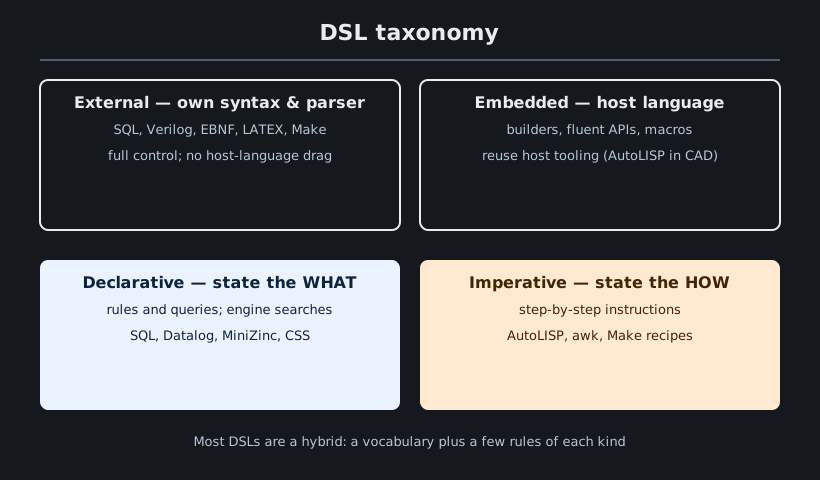
Figure 1 — External or embedded, declarative or imperative: most DSLs are a hybrid of the two shapes.
External vs. Embedded
External DSLs have their own syntax and parser (SQL, Verilog, EBNF, Make); they are clean but cost a toolchain. Embedded DSLs live inside a host language as builders, fluent APIs, or macros, inheriting the host’s tooling for free — the pragmatic default for internal tools.
Declarative vs. Imperative
Declarative DSLs state the what and let an engine decide the how (SQL, Datalog, MiniZinc); they are easier to reason about and verify. Imperative DSLs give explicit steps (AutoLISP, awk scripts); they are more flexible and harder to analyze. Specifications should pick the axis that matches the user’s mental model.
Why Use a DSL
DSLs trade away generality to buy productivity, safety, and communication inside their domain. The same trade is examined as a decision process in Design Considerations.
Benefits
- Abstraction: domain experts read and write the activity itself (a query, a bot recipe).
- Safety: the small grammar makes invalid states unexpressible — a booking DSL cannot “book minus one room”.
- Productivity: one line of SQL replaces fifty lines of imperative glue.
- Automation: a tool’s users can script it (AutoLISP, Emacs Lisp) without learning a general language.
Costs
Every DSL pays: a parser and evaluations rules to build, documentation to keep, and a grammar that can quietly rot into a general-purpose language. The bill is only sensible when the domain is stable and the users are numerous.
Famous DSL Examples
Surrounding yourself with existing DSLs is the fastest way to develop taste.
A Field Guide
- SQL — declarative queries and data manipulation; the most successful DSL ever.
- Verilog / VHDL — hardware description (this roadmap, Phase 3).
- regex — pattern matching in one dense vocabulary.
- Make — dependency rules with shell recipes.
- HTML/CSS — document structure and style as markup DSLs.
- gnuplot, LaTeX, PostScript — graphics, typesetting, and printing as languages.
- EBNF — a DSL for describing other languages (this chapter family).
Why DSLs Succeed or Fail
The distinction is rarely technical; it is scope discipline.
Success Factors
A clear, bounded domain; a vocabulary that matches how experts already talk; examples in the documentation; and tooling that fails with the user, not at them.
Failure Modes
Feature creep into general-purpose territory, no written grammar or examples, “yet another config language” with no measurable win, and a designer who never named the problem — the exact red flags listed in Critical Thinking.
Example: Same Task, Two Shapes
Filter users who are at least 30 years old. Write it in a general language and in a query-style DSL to feel the abstraction gap.
Imperative (Python)
# users.py — general-purpose version
result = []
for user in users:                  # explicit loop over the data
    if user.age >= 30:              # explicit comparison
        result.append(user.name)    # manual accumulation
print(result)
Declarative (SQL-style DSL)
-- query.sql — the same task as a domain statement
SELECT name FROM users WHERE age >= 30;
Both do the same work. The SQL line is a statement about the data; the engine supplies the iteration, filtering, and output. That is the difference a DSL makes: less code to read, no loop to get wrong, and a grammar that cannot express “where user … …” incorrectly.
Next Steps
Continue Phase 1
The scope is set. Before designing, read Design Considerations to decide whether a language is justified, then learn how its surface is built: Syntax & Notation, Grammar & Rules, and Parsing & Trees.