
Elixir: Collections & Enumeration
Enum and Stream are the workhorses of Elixir data processing. This lesson
covers eager and lazy pipelines, comprehensions, sets, and — importantly — which structure to pick
when the data gets large.
Enum: Eager Pipelines
Enum functions consume the whole collection and return a new one. Each step is a full
pass — perfect for everyday sizes, wasteful for huge or infinite ones.
orders = [
  %{id: 1, user: "ada", total: 120, status: :paid},
  %{id: 2, user: "grace", total: 80, status: :pending},
  %{id: 3, user: "ada", total: 200, status: :paid}
]

orders
|> Enum.filter(&(&1.status == :paid))        # keep paid orders
|> Enum.map(&(&1.total))                     # project the totals
|> Enum.sum()                                #=> 320

# Reduce is the universal fold — every other Enum function can be
# expressed with it. Grouping paid orders by user:
orders
|> Enum.filter(&(&1.status == :paid))
|> Enum.reduce(%{}, fn o, acc ->
      Map.update(acc, o.user, o.total, &(&1 + o.total))
    end)                                       #=> %{"ada" => 320}
Stream: Lazy Pipelines
Stream builds the pipeline as a description — nothing runs until you call a terminal
function like Enum.to_list/1. Elements flow through the whole chain one at a time,
which means constant memory and support for infinite sources.
# Infinite generator: even numbers, forever.
Stream.iterate(0, &(&1 + 2))
|> Stream.map(&(&1 * &1))               # squares
|> Stream.take(5)                       # only 5 elements are pulled
|> Enum.to_list()                       #=> [0, 4, 16, 36, 64]

# File lines are streamed — the file never loads fully into memory.
File.stream!("access.log")
|> Stream.map(&String.trim_trailing/1)
|> Stream.filter(&String.contains?(&1, "ERROR"))
|> Stream.take(10)                      # stop reading after 10 matches
|> Enum.to_list()| Choose | When | Why |
|---|---|---|
Enum | in-memory data, few steps, you want intermediate values | each step is a simple full pass |
Stream | large or unbounded data, many chained steps, files/network | single pass, constant memory, early termination |
Comprehensions
The for special form maps, filters, and flattens in one readable expression, over any
number of generators. It is often clearer than the equivalent Enum chain — especially
when combining two collections.
# One generator with a filter, collecting into a list (default).
for {:ok, v} <- results, v > 10, do: v

# Two generators — a Cartesian product with a filter.
for x <- [1, 2, 3], y <- [:a, :b], y != :a or x > 1, do: {x, y}
#=> [{1, :b}, {2, :a}, {2, :b}, {3, :a}, {3, :b}]

# `into:` picks the destination structure — here a map of squares.
for i <- 1..4, into: %{}, do: {i, i * i}
#=> %{1 => 1, 2 => 4, 3 => 9, 4 => 16}
Sets and Other Structures
MapSet is the standard set: unique elements, fast membership. Date.Range,
maps, and even binaries all work with Enum because they implement the
Enumerable protocol (next lesson).
s = MapSet.new([1, 2, 3])
MapSet.union(s, MapSet.new([3, 4]))    #=> #MapSet<[1, 2, 3, 4]>
MapSet.subset?(MapSet.new([1]), s)     #=> true
3 in s                                 #=> true — membership is cheap
Choosing the Structure
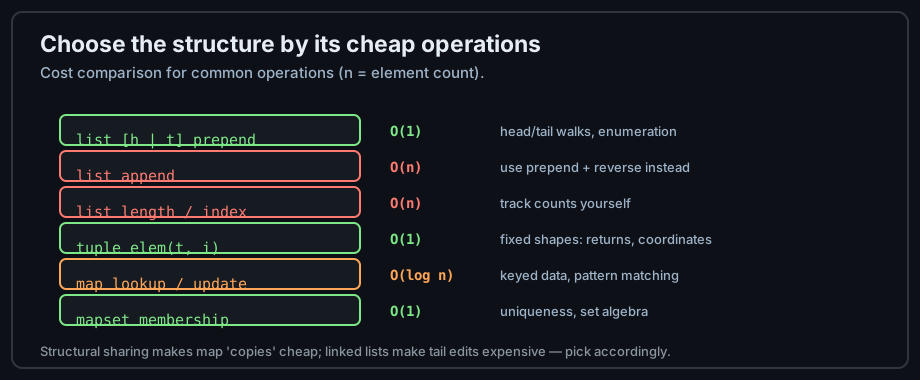
| Structure | Cheap operation | Expensive operation | Reach for it when… |
|---|---|---|---|
| List | prepend, head/tail walk | index, append, length | enumerating in order |
| Tuple | index access | insert/remove | fixed shape (returns, coordinates) |
| Map | key access, update | ordered traversal | keyed lookups and pattern matching |
| MapSet | membership, union | indexing | uniqueness and set algebra |
| Keyword list | reading options | lookup by key (O(n)) | function options, ordered small pairs |
Practice
- Rewrite the orders example with a comprehension instead of
Enum.filter + Enum.map. - Stream the words of a large text file and find the 10 most frequent words (
Enum.frequencies/1thenEnum.sort/1). - Convert a list pipeline into a
Streampipeline and explain which version terminates early onFile.stream!input.