
Elixir: Distributed Elixir
send/2 as a local one. This lesson covers the mechanics, the conveniences, and —
honestly — the failure modes.
Nodes and Cookies
# Start two nodes on one machine and connect them.
iex --sname alpha@localhost --cookie secret
iex --sname beta@localhost  --cookie secret

# In alpha:
Node.connect(:"beta@localhost")     #=> true — now they're a cluster
Node.list()                         #=> [:"beta@localhost"]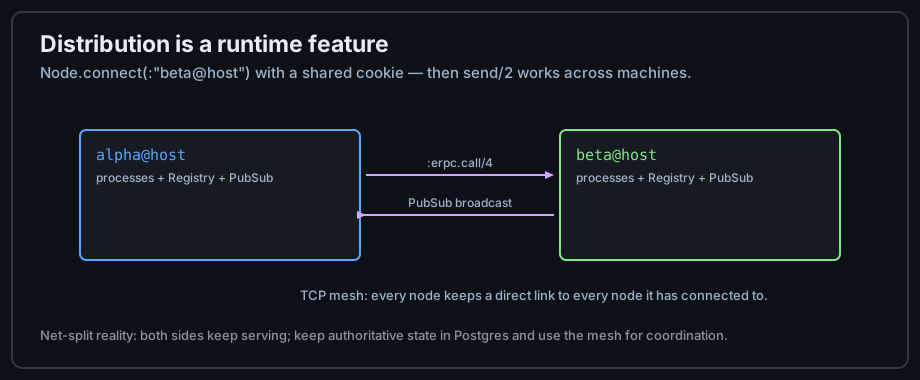
Calling Across Nodes
# :erpc runs a function on a remote node — the simplest remote call.
:erpc.call(:"beta@localhost", MyApp.Health, :check, [], 5_000)

# Broadcast a computation to every node in the cluster:
:erpc.multicall(Node.list(), MyApp.Health, :check, [])

# You can even spawn a process on a remote node (rarely the right tool,
# but important to understand):
Node.spawn(:"beta@localhost", fn ->
  IO.puts("running on #{node()}")
end)
Style note: prefer services with APIs over Node.spawn for real systems —
remote-spawn code couples deployment topology into function bodies. Use distribution for
registration, PubSub, and cluster-aware coordination.
Clustering in Production
Manual Node.connect works for experiments; real clusters form automatically.
libcluster discovers nodes via DNS, Kubernetes API, or multicast — you configure a
strategy once and the mesh maintains itself.
# mix.exs: {:libcluster, "~> 3.3"}

# application.ex — start the cluster topology with the tree.
children = [
  {Cluster.Supervisor, [topologies()]},
  MyApp.Repo,
  # ...
]

defp topologies do
  [
    k8s: [
      strategy: Cluster.Strategy.Kubernetes,
      config: [kubernetes_node_suffix: System.get_env("NAMESPACE"),
               kubernetes_selector: "app=my-app"]
    ]
  ]
end
Global Names and PubSub
Three registration levels, three scopes. :global keeps exactly one process per name in
the whole cluster (a leader election of sorts). Registry with
keys: :duplicate plus Phoenix.PubSub broadcast to every interested
process across nodes — the machinery behind LiveView presence and channels.
# One-per-cluster process (e.g., a scheduler that must run exactly once):
case :global.register_name(:my_app_scheduler, pid) do
  :yes -> :ok
  :no  -> :already_taken      # another node owns it — stand down
end

# Cluster-wide publish/subscribe (started in the tree as
# {Phoenix.PubSub, name: MyApp.PubSub}):
Phoenix.PubSub.subscribe(MyApp.PubSub, "prices:BTC")
Phoenix.PubSub.broadcast(MyApp.PubSub, "prices:BTC", {:tick, 67_432})
Net-Splits and the CAP Reality
The BEAM default is availability with risk: after a partition heals, disconnected nodes
reconnect and both sides keep running in the meantime — which can mean two processes believing
they own :global resources. Production answers, in order of commonality:
- Keep cluster state advisory. Authoritative state lives in Postgres/Redis; the cluster coordinates, it does not own.
- Consensus for critical coordination: Raft (used by RabbitMQ's Khepri) or libraries like
horde+delta_crdtfor eventually-consistent registration. - Restart partitioned nodes: some teams run the VM under a heart/supervisor that reboots a node when it detects isolation; most teams prefer keeping state advisory instead.
The pragmatic rule: use distribution for mesh convenience (pubsub, presence, monitoring), reach for consensus only when double-execution is catastrophic.
Practice
- Start two nodes with the same cookie, connect them, and call
:erpc.call/4both ways. - Register a process under
:globalon both nodes and observe which wins; kill it and watch the other take over. - Set up PubSub on both nodes and verify a broadcast from one arrives on the other.
Next: Data & Ecto