
Elixir: Supervision Trees
The First Supervisor
defmodule MyApp.Supervisor do
  use Supervisor    # the behaviour for static trees

  def start_link(init_arg), do:
    Supervisor.start_link(__MODULE__, init_arg, name: __MODULE__)

  @impl true
  def init(_init_arg) do
    # children: a list of child specs. ORDER = boot order, reversed = shutdown.
    children = [
      # Start order: registry first, then cache, then workers.
      {Registry, keys: :unique, name: MyApp.Registry},
      {MyApp.Cache, name: MyApp.Cache},
      {Task.Supervisor, name: MyApp.TaskSup}
    ]

    # one_for_one: a crashed child restarts ALONE, the rest keep running.
    Supervisor.init(children, strategy: :one_for_one)
  end
end

# Manual boot for scripts and experiments (real apps start it via the
# application callback — see the next lesson):
Supervisor.start_link(MyApp.Supervisor, [])
Restart Strategies
| Strategy | On a child crash | Use when |
|---|---|---|
:one_for_one | only that child restarts | independent children (the default choice) |
:one_for_all | all children restart | children are useless without each other |
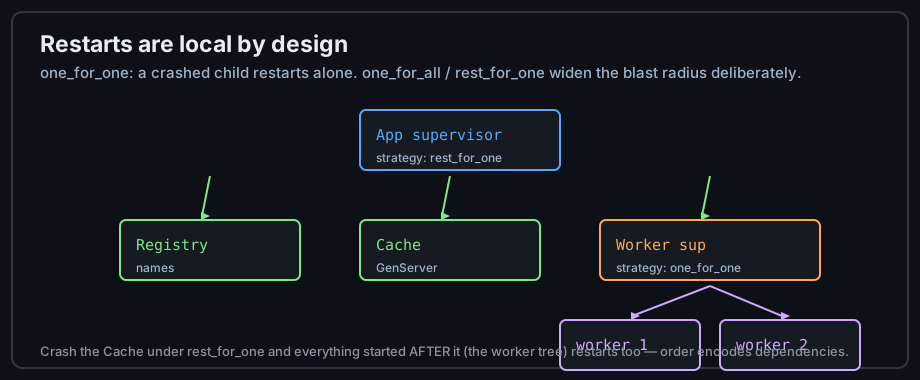
:rest_for_one | the crashed child and everything started after it | later children depend on earlier ones |
Restart intensity protects the system from crash loops: max_restarts failures within
max_seconds (defaults: 3 in 5) take the supervisor itself down — escalating
the failure one level up the tree. That "give up and let the parent decide" rule is what makes
transient bugs self-healing instead of wedge-shaped.
DynamicSupervisor
Static trees know their children at compile time. When children appear at runtime — one process per
user connection, per game, per upload — DynamicSupervisor starts and supervises them
on demand, and pairs with a Registry for name-based lookup.
# In the tree: {DynamicSupervisor, name: MyApp.SessionSup}

# Later, at runtime — "supervise a session for user 42":
{:ok, pid} =
  DynamicSupervisor.start_child(MyApp.SessionSup, %{
    id: {MyApp.Session, 42},
    start: {MyApp.Session, :start_link, [[user_id: 42]]},
    restart: :transient          # restart on abnormal exit only
  })

DynamicSupervisor.count_children(MyApp.SessionSup)
DynamicSupervisor.terminate_child(MyApp.SessionSup, pid)
restart: :temporary and :transient matter here: a crashed session should
restart, but a finished session should not resurrect itself.
Designing Fault Domains
The tree is your failure architecture. Rules that hold up in production:
- One concern per supervisor. A crashed HTTP pool should not restart your DNS resolver.
- Restart cheap things, rebuild expensive things. A cache server can be
:permanent; a connection pool with a slow warm-up wants a strategy that avoids flapping. - State that must survive a crash lives outside the process — ETS table owned by a separate "guardian" process, or persisted with Ecto.
- Watch your own intensity limits: defaults are sensible; tune
max_restarts/max_secondsonly with a reason.
Practice
- Start the supervisor above in
iex, find a child pid withSupervisor.which_children/1, and kill it — watch the restart. - Change the strategy to
:one_for_alland repeat; explain the difference in what restarted. - Build a DynamicSupervisor that hosts one
MyApp.SessionGenServer per user id, then terminate one session by name.