
Methods & Multiple Dispatch
The previous lesson taught you to define types; this one teaches you how behaviour attaches to them. You will see how methods are declared, how specificity selects a winner, what happens when two signatures are equally good, how optional and keyword arguments generate extra methods, and how packages extend each other's functions without touching the original code. The chapter on patterns shows how dispatch replaces design patterns you may know from object-oriented languages, and the pitfalls chapter covers the two failure modes you will actually hit: ambiguity and arguments typed too loosely.
Functions and Methods
The distinction between a function and a method is the first thing to internalise. A function is a name; methods are the implementations stored under that name, keyed by their argument type signature.
One Generic Function, Many Methods
typeof(+) is not a closure or a pointer — it is an object of type typeof(+), a generic function with well over a hundred methods for numbers, strings, arrays, dates, and anything a package adds later. Writing + for your own type does not replace the built-in; it adds one more method to the same function.
# + is a single generic function with a large method table
typeof(+)                  # typeof(+)
length(methods(+))         # a large number, growing with every loaded package

# Every method declares a signature over argument types
m = which(+, (Int, Int))   # the method used for 1 + 1
m.sig                      # Tuple{typeof(+), Int64, Int64} — a signature, not a body

# A generic function with no methods is legal and normal
function describe end       # an empty generic function used by packages as an API

describe(1)                 # ERROR: MethodError — no methods defined yet

# Adding methods later works because the name already exists
describe(x::Int) = "integer $x"
describe(x::String) = "text: $x"
describe(1)                 # "integer 1"
describe("hi")              # "text: hi"

# The generic function is now the shared entry point for both methods
methods(describe)           # 2 methods
Declaring function describe end is a deliberate design move, not a curiosity: it publishes a name and a docstring so other packages can attach methods in their own files, and it keeps MethodError messages informative when a type is missing an implementation.
Defining Methods
The long and short forms are equivalent; annotation of arguments is what creates a new method. Two definitions with different type signatures coexist, while two definitions with the same signature replace each other — a rule worth remembering while experimenting in the REPL.
# Long form
function scale(x::Number, factor::Number)
    x * factor
end

# Short form — identical semantics
scale(x::Int, factor::Int) = x * factor

# A method with no type annotations accepts anything
scale(x, factor) = "cannot scale $x"

scale(2.0, 3.0)            # 6.0 — the Number method
scale(2, 3)                # 6   — the Int method, which is more specific
scale("two", 3)            # "cannot scale two" — the untyped fallback

# Methods for the same name live in one table, ordered by specificity
methods(scale)             # 3 methods: (Any, Any), (Number, Number), (Int, Int)

# The body of a methods list tells you the file and line of each definition
for m in methods(scale)
    println(m.sig)
end
Note how the untyped fallback never interferes: it exists so unhandled types produce a helpful message instead of a bare MethodError. That pattern — a specific method, an abstract method, and a total fallback — scales well across a whole package.
Inspecting Methods
When a call behaves unexpectedly, ask which method ran rather than guessing. Julia offers several tools for exactly this, and they are worth learning early because dispatch decisions are made by the compiler, not by reading order in a file.
using InteractiveUtils      # @which, @code_typed and friends

scale(2, 3)

@which scale(2, 3)          # points at the (Int, Int) method
@which scale(2.0, 3.0)      # points at the (Number, Number) method
@which scale("a", "b")      # points at the (Any, Any) method

# The three-argument form reports which method a call WOULD use
which(scale, (Int, Int))

# The signature of a method, fully qualified
m = which(scale, (Int, Int))
m.sig                       # Tuple{typeof(scale), Int64, Int64}

# hasmethod answers the question without running anything
hasmethod(scale, Tuple{Int, Int})       # true
hasmethod(scale, Tuple{Symbol, Int})    # true — the fallback accepts it

# For performance questions, look at the inferred code instead
@code_typed scale(2, 3)
@which is the fastest way out of a dispatch mystery, and hasmethod is the tool for validating call sites in tests: assert that the method you expect exists before asserting what it returns.
How Dispatch Works
Dispatch is a comparison of signatures. Julia takes the types of the arguments at the call site and finds the most specific method that accepts them, using subtype relationships rather than any kind of number or declaration order.
Specificity and Method Order
A method A is more specific than B when every type in A's signature is a subtype of the corresponding type in B's. The order in which you wrote the definitions is irrelevant — only the types matter. The diagram below shows the three-level ladder you will write most often.
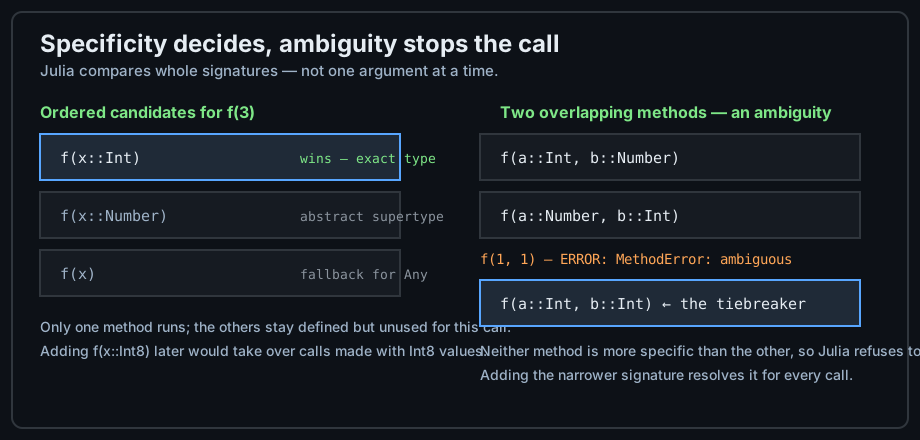
f(x::Int) = "exact Int"
f(x::Number) = "some Number"
f(x) = "anything else"

f(3)          # "exact Int"      — Int is a subtype of Number, fastest match wins
f(3.5)        # "some Number"    — Float64 is not an Int, but is a Number
f("three")    # "anything else"  — only the fallback accepts a String

# Definition order does not change the outcome
f(x) = "anything else"           # redefining the fallback does not steal Int calls
f(3)          # "exact Int"

# A narrower type added later wins immediately
f(x::Int8) = "exact Int8"
f(Int8(3))    # "exact Int8"
f(3)          # "exact Int"      — Int64 still matches Int, not Int8

# Check the winner instead of guessing
@which f(Int16(3))               # ...(x::Number) — Int16 promotes into the Number method
Note the direction of the ladder: write the narrowest method first, then progressively broader ones, and end with an untyped fallback only if you want a friendly message. The compiler does the ordering for you.
Dispatch on Several Arguments
Dispatch considers every argument at once — that is the "multiple" in multiple dispatch, and it is where Julia differs most from single-dispatch languages. Two arguments give you a two-dimensional grid of methods, and the winner must be at least as specific as any other candidate in all positions.
# A two-argument grid: shape x colour
abstract type Shape end
struct Circle   <: Shape; r::Float64; end
struct Square   <: Shape; side::Float64; end
struct Triangle <: Shape; base::Float64; height::Float64; end
abstract type Colour end
struct RGB <: Colour; r::Int; g::Int; b::Int; end
struct HSV <: Colour; h::Int; s::Int; v::Int; end

paint(s::Circle, c::RGB) = "circle painted"
paint(s::Square, c::RGB) = "square painted"
paint(s::Shape, c::Colour) = "shape painted generically"

paint(Circle(1.0), RGB(1, 0, 0))         # "circle painted" — both arguments fit the specific method
paint(Triangle(1.0, 1.0), HSV(0, 1, 1))  # "shape painted generically" — only the broad method fits

# Methods can also dispatch on the container, not only on its elements
total(xs::Vector{Int}) = sum(xs)
total(xs::Vector{T}) where {T <: Number} = sum(xs)
total(xs::AbstractVector) = "unsupported vector"

total([1, 2, 3])                    # 6 — Vector{Int} is the most specific
total([1.5, 2.5])                   # 4.0 — Vector{Float64} matches the unionall method

# Dispatch on the number of arguments is dispatch too
area(s::Square) = s.side^2
area(w::Number, h::Number) = w * h

area(Square(2.0))                   # 4.0
area(3.0, 4.0)                      # 12.0
That second block is the idiom for generic collections: a concrete-element method for the fast path, a parametric method for the general case, and an abstract method for containers you cannot handle yet. Chapter 5 returns to it as a pattern.
Ambiguity
Sometimes two methods both apply and neither is more specific. Julia refuses to guess and raises a MethodError naming the ambiguity. The cure is a method that is narrower than both, which also documents the intended behaviour.
f(a::Int, b::Number) = "a is Int"
f(a::Number, b::Int) = "b is Int"

f(1, 2)                # ERROR: MethodError. Ambiguous: both methods apply equally

# Neither signature is more specific: Int/Number is not a subtype of Number/Int
# because the two positions disagree. Add the intersection explicitly.
f(a::Int, b::Int) = "both are Int"
f(1, 2)                # "both are Int"

# The other methods still work for mixed arguments
f(1, 2.5)              # "a is Int"
f(1.5, 2)              # "b is Int"

# Detect ambiguity in tests before users find it
methods(f)             # four methods now; the REPL warns when a pair overlaps

# Remove the tiebreaker and the call fails again — ambiguity is a runtime error
# f(1, 2)              # ERROR: MethodError: ambiguous
Julia warns you about this before you run anything: redefining a method in the REPL prints possible method call error(s) whenever the new definition creates an overlap with an existing one. Treat that warning as an error, and add the intersection method it asks for.
Optional and Keyword Arguments
Most real functions accept a variable number of arguments. Julia implements that with default positional arguments — which generate extra methods — and with keyword arguments, which do not participate in dispatch at all. Both facts have practical consequences.
Default Positional Arguments
A default value is shorthand: Julia generates one method per combination of supplied arguments, all delegating to the full version. That is why defaults cost nothing at runtime, and why they must always come last in the parameter list.
function greet(name::String, greeting::String = "Hello", punct::String = "!")
    "$greeting, $name$punct"
end

# Three methods were generated automatically
methods(greet)         # (String,), (String, String), (String, String, String)

greet("Ada")                        # "Hello, Ada!"
greet("Ada", "Hi")                  # "Hi, Ada!"
greet("Ada", "Hi", ".")             # "Hi, Ada."

# Defaults may depend on earlier arguments
function make_grid(rows::Int, cols::Int = rows)
    (rows, cols)
end

make_grid(3)                        # (3, 3)
make_grid(3, 5)                     # (3, 5)

# A default argument can be omitted only from the right
greet(greeting = "Hi")              # ERROR: MethodError — use keywords for this
If you find yourself wanting to skip a positional argument in the middle, that is the signal to switch to keyword arguments — they exist precisely for that case.
Keyword Arguments
Keyword arguments are written after a semicolon, may be supplied in any order, and have their own defaults. Crucially, a function with keywords still has a single method: the keywords are collected into a named tuple, so they cannot be dispatched on.
function greet(name::String; greeting::AbstractString = "Hello", punct::AbstractString = "!")
    "$greeting, $name$punct"
end

# One method only
length(methods(greet))              # 1

greet("Ada")                        # "Hello, Ada!"
greet("Ada"; punct = ".")           # "Hello, Ada."
greet("Ada", greeting = "Hi")       # "Hi, Ada!" — semicolon optional at a call site

# Sloppy keywords are an error, not silently ignored
greet("Ada"; hola = "Hi")           # ERROR: MethodError: unsupported keyword argument

# Keyword stuffing: pass a named tuple through
opts = (greeting = "Hey", punct = "...")
greet("Ada"; opts...)               # "Hey, Ada..."

# Dispatch happens on the positional part only
greet(name::Symbol; greeting = "Hello") = "$greeting, symbol $name"
greet(:ada)                         # "Hello, symbol ada" — the Symbol method
greet("Ada")                        # "Hello, Ada!"      — the String method
The last example is the key rule: two methods may have identical keywords and still be different methods, because keywords are not part of the signature. Type them loosely and validate inside, or convert to a positional argument if dispatch must depend on them.
Splatting and Varargs
Varargs parameters and splatting call sites are the flexible middle ground: they let a function accept any number of arguments while still dispatching on the ones you care about.
# Varargs: xs is a tuple of the remaining arguments
sum_all(xs...) = sum(xs)
sum_all()                           # 0
sum_all(1, 2, 3, 4)                 # 10

# Typed varargs dispatch on the element type
join_strings(sep::String, parts::String...) = join(parts, sep)
join_strings("-", "a", "b", "c")    # "a-b-c"

# Mixing a required argument with varargs is common
function report(title::String, lines::String...)
    title * "\n" * join(lines, "\n")
end

# Splat at the call site spreads a collection into the parameters
args = [1, 2, 3]
sum_all(args...)                    # 6
join_strings("-", ["a", "b"]...)    # "a-b"

# Keywords can be splatted too, which is how options travel through wrappers
opts = (greeting = "Hi",)
greet("Ada"; opts...)
One warning from the performance chapter: a varargs method is a single method that receives a tuple, so it will not specialise per arity as aggressively as separate methods. For two or three arguments, write explicit methods instead.
Extending and Sharing Methods
Methods belong to functions, and functions belong to modules — but any module may add methods to a function it did not define, as long as it owns at least one of the types involved. That single rule is what makes the ecosystem composable, and it has exactly one well-known abuse.
Adding Methods to Existing Functions
You extend a function by importing it and defining a new method. Writing Base.show and writing import Base: show then show are equivalent for methods, but the imported form is clearer about what you are doing: adding to an existing function rather than defining a new one.
struct Money
    amount::Float64
    currency::String
end

# Extending printing for your own type
import Base: show, +, ==

function show(io::IO, m::Money)
    print(io, m.currency, " ", round(m.amount; digits = 2))
end

Money(19.5, "EUR")            # prints as  EUR 19.5

# Extending arithmetic: line up the argument types
+(a::Money, b::Money) = a.currency == b.currency ? Money(a.amount + b.amount, a.currency) :
                        throw(ArgumentError("currency mismatch"))
+(a::Money, x::Number) = Money(a.amount + x, a.currency)
+(x::Number, a::Money) = a + x          # symmetry matters

Money(10.0, "EUR") + Money(5.0, "EUR")  # EUR 15.0
Money(10.0, "EUR") + 2.5                # EUR 12.5
2.5 + Money(10.0, "EUR")                # EUR 12.5

# Extending equality requires extending hash for container correctness
==(a::Money, b::Money) = a.currency == b.currency && a.amount == b.amount
import Base: hash
hash(m::Money, h::UInt) = hash(m.amount, hash(m.currency, h))
Notice the symmetry line: when you add +(Money, Number), also add +(Number, Money). Users write both orders, and Julia will not guess that one implies the other.
Type Piracy
Type piracy is defining a method whose function and whose argument types all come from other packages. It works, it compiles, and it silently changes behaviour for every other user of those packages — the classic case being a new method for Base.isequal on two standard types.
# Piracy: Base.isequal belongs to Base, Int belongs to Base —
# this module owns nothing in the signature.
import Base: isequal
isequal(a::Int, b::Int) = a % 10 == b % 10      # 11 == 21 becomes true for everyone

# Legal: at least one type is yours
struct Celsius; t::Float64; end
import Base: isequal
isequal(a::Celsius, b::Celsius) = a.t == b.t    # fine — Celsius is owned here

# Legal and common: your type combined with a library type
struct Wrapped; io::IO; end
import Base: write
write(w::Wrapped, x) = write(w.io, string(x))   # fine — Wrapped is owned here

# The safe alternative to piracy: define your own function instead
approx_equal(a::Int, b::Int; mod = 10) = a % mod == b % mod
approx_equal(11, 21)                            # true, and nobody else is affected
If a pirated method seems necessary, the fix is usually a new function in your own namespace, or a wrapper type that makes one of the arguments yours. Both preserve composability, which is the property that makes Julia's ecosystem usable at all.
Interfaces Are Informal
Julia has no interface keyword. An interface is a documented set of methods a type must implement, checked by calling them rather than by the compiler. That is more flexible than it sounds, because failure is precise: calling a missing method names the exact signature that is absent.
| Interface | Methods a type must provide | Typical implementers |
|---|---|---|
| Iteration | iterate (plus eltype, IteratorSize) | arrays, ranges, generators |
| Indexing | getindex, size, length | arrays, dictionaries, custom matrices |
| Display | show(io, x) | almost every type in the ecosystem |
| Conversion | convert, promote_rule | numbers, dates, units |
| Comparison | ==, hash, isless | values used as keys or sorted |
# A minimal iterable: implement iterate and the for-loop protocol works
struct Countdown
    from::Int
end

function Base.iterate(c::Countdown, state = c.from)
    state < 1 && return nothing              # no more elements
    (state, state - 1)                        # element, next state
end

collect(Countdown(3))        # [3, 2, 1]
[c^2 for c in Countdown(4)]  # [16, 9, 4, 1]

# Anything that defines iterate is usable by every function that consumes iterators
sum(Countdown(4))            # 10
first(Countdown(5))          # 5

# A missing method names itself, which is the entire error message you need
struct Broken; end
iterate(Broken())            # ERROR: no method matching iterate(::Broken)
Because interfaces are informal, packages document them in docstrings and test them with a conformance suite. When you implement one, add a test that exercises each required method — that test is your interface declaration.
Dispatch Patterns in Practice
Because dispatch is the only mechanism Julia has, a few patterns appear constantly in real packages. Learning to recognise them turns unfamiliar library code into something you can read.
Traits: Dispatch on Capabilities
A trait is a function that answers a question about a type, returning a value the dispatcher can use. It lets you choose behaviour by capability rather than by ancestry — the standard library does this with IteratorSize and IteratorEltype.
# Traits are plain functions returning a small, dispatchable value
abstract type Storage end
struct Dense  <: Storage end
struct Sparse <: Storage end
struct Lazy   <: Storage end

storage_kind(::AbstractArray) = Dense()
storage_kind(::SparseMatrixCSC) = Sparse()   # SparseMatrixCSC lives in SparseArrays.jl
storage_kind(::AbstractRange) = Lazy()

# Behaviour is selected by the trait, not by the concrete type
function how_to_sum(x)
    kind = storage_kind(x)
    how_to_sum(kind, x)               # dispatch on the trait value
end

how_to_sum(::Dense, x) = sum(x)
how_to_sum(::Sparse, x) = nnz(x) == 0 ? zero(eltype(x)) : sum(x)
how_to_sum(::Lazy, x) = sum(x)        # closed form, no storage at all

how_to_sum([1, 2, 3])                 # 6
how_to_sum(1:10)                      # 55

# New capabilities are added by new trait values, never by editing old methods
struct GpuArray <: AbstractArray end
storage_kind(::GpuArray) = Dense()
The other common trait style uses Val and types rather than singleton instances, which keeps the choice in the type domain and lets the compiler fold it away. Either way, the trait is a function of a type — package authors rely on this to support types that do not exist yet.
The Container Pattern
Functions that operate on collections are usually written as a small ladder: one method per level of concreteness. Getting the ladder right means your function works on arrays, ranges, views, and anyone else's container without changes.
# Level 1: the most specific, fastest path
row_sum(m::Matrix{Float64}) = sum(m; dims = 2)

# Level 2: the same algorithm for any element type
row_sum(m::AbstractMatrix{T}) where {T <: Number} = sum(m; dims = 2)

# Level 3: a general fallback that still works, just slower
row_sum(m::AbstractMatrix) = [sum(@view m[i, :]) for i in axes(m, 1)]

# Level 4: a friendly error for anything else
row_sum(x) = throw(ArgumentError("row_sum expects a matrix, got $(typeof(x))"))

row_sum([1.0 2.0; 3.0 4.0])   # [3.0, 7.0]
row_sum([1 2; 3 4])           # [3, 7]
row_sum("not a matrix")       # ERROR: ArgumentError: row_sum expects a matrix

# The same ladder applied to a predicate argument
count_if(f::F, xs::AbstractVector) where {F <: Function} = count(f, xs)
count_if(f, xs) = count(f, xs)     # any iterable works too
count_if(isodd, [1, 2, 3, 4])      # 2
Write the ladder in that order and you get three things at once: optimal performance for the common case, generality for everything else, and a readable error instead of MethodError when a caller misunderstands the API.
What Dispatch Costs
Dispatch is decided once per call site, at compile time, through type inference. When the argument types are concrete, the call is a direct jump — there is no lookup table consulted at runtime. Only when a type cannot be inferred does dispatch become dynamic, and that is a type-instability problem, not a dispatch problem.
function add_all(xs)
    total = 0
    for x in xs
        total += x          # x is inferred as the element type of xs
    end
    total
end

@code_warntype add_all([1, 2, 3])       # total::Int64 — fully inferred
@code_warntype add_all(Any[1, 2, 3])    # total::Any   — element type is Any

# Union splitting: a small union is resolved at compile time
function maybe(x::Union{Int, Nothing})
    x === nothing ? 0 : x + 1
end

@code_warntype maybe(1)                 # no dispatch, the branch is eliminated

# A large union or an abstract field forces a real runtime lookup
function loose(x)
    x isa Int ? x + 1 : "other"         # the compiler keeps both paths
end

@code_warntype loose(1)
The practical rule: dispatch on types you can name, keep argument types concrete, and use @code_warntype when you suspect a hot loop is paying for a dynamic lookup. Packages such as Traceur, BenchmarkTools, and @code_typed give you the detail when a profile points at dispatch.
Common Pitfalls
Three habits cause most dispatch bugs: leaving arguments untyped where a type was meant, assuming that a method definition replaces the function, and branching inside a body instead of outside it. Each has a mechanical diagnosis.
Arguments Typed Too Loosely
An untyped argument accepts everything, which means a fallback method silently swallows call sites you did not intend. This is the polite version of a dispatch bug: no error, wrong branch, hard to find in a large program.
# The fallback hides every mistake
process(x) = "unhandled: $(typeof(x))"
process(x::Int) = x * 2

process(3)          # 6
process(3.0)        # "unhandled: Float64"  — did you intend this?
process("3")        # "unhandled: String"   — or should this be an error?

# A typed set of methods is more honest: an abstract type still documents intent
render(x::AbstractString) = "text: $x"
render(x::Number) = "number: $x"
# no untyped method — unknown types raise MethodError with the exact signature

render(3.0)         # "number: 3.0"
render(:sym)        # ERROR: MethodError: no method matching render(::Symbol)

# When flexibility is real, use a type parameter and pass it through
identity_of(x::T) where {T} = (x, T)
identity_of(3.0)    # (3.0, Float64)
identity_of("a")    # ("a", String)
The rule: write a fallback only when you genuinely want one, and prefer an abstract type to no annotation at all. A MethodError at the call site is worth more than a mystery string in a log.
Redefinition and Stale Sessions
Defining a method with the same signature twice replaces the old one; defining it with a new signature adds a method. In a long REPL session or a precompiled package, that difference explains behaviour which "cannot happen".
f(x::Int) = "first definition"
f(x::Int) = "second definition"     # replaces: same signature

f(1)                                # "second definition" — one method, not two
length(methods(f))                  # 1

f(x::Float64) = "added"             # adds: different signature
length(methods(f))                  # 2

# Inside a script, the last definition in the file wins, in file order.
# Inside a precompiled package, methods are fixed when the package is built.
Pkg.precompile()                    # after editing a package's methods
When you fight a stale method, restart the session or precompile: Julia's method table is per-process, and a definition from an earlier experiment stays visible until the module is reloaded.
Branching Inside Instead of Dispatching Outside
The most common design smell in Julia code is a chain of if x isa ... inside one function body. It works, but it hides the extension point, defeats specialisation, and makes the method table invisible.
| Inside the body (avoid) | As methods (prefer) |
|---|---|
if x isa Cat ... elseif x isa Dog ... | speak(c::Cat) = ..., speak(d::Dog) = ... |
| The file must change for every new type | A new type adds a method, no edits elsewhere |
The compiler sees one generic body with Any inside | Each method is specialised on concrete types |
@which shows one large method | @which names the exact implementation |
| Errors say "unexpected type" | Errors name the missing signature |
# Before: one function, every type known in advance
function sound(animal)
    if animal isa Dog
        "woof"
    elseif animal isa Cat
        "meow"
    else
        "unknown animal"
    end
end

# After: one method per type, open for extension
abstract type Animal end
struct Dog <: Animal end
struct Cat <: Animal end

sound(::Dog) = "woof"
sound(::Cat) = "meow"
sound(::Animal) = "some animal noise"   # default for types that accept the contract

struct Cow <: Animal end
sound(::Cow) = "moo"                    # one line; nothing else in the file changes

sounds = [Dog(), Cat(), Cow()]
sound.(sounds)                          # ["woof", "meow", "moo"]
Refactoring if isa chains into methods is the highest-value change you can make in Julia code: it shortens the file, opens it for extension, and gives the compiler a concrete type at every call site.
if isa chains, traits select behaviour by capability, and a container ladder covers fast, generic, and unsupported cases in four short methods.
You can now define types and attach behaviour to them. Next: Parametric Types & Generics generalises both, so a single definition serves every element type without giving up speed.