
Why TypeScript Exists
You already write JavaScript well. So the honest first question is not how TypeScript works but why it exists at all — what problem it solves that your current workflow does not. This page answers that with the failure pattern you have already lived through, the mechanism TypeScript uses to fix it, and the honest counter-examples where TypeScript is not worth it.
The problem JavaScript hands you
JavaScript is dynamically typed: a value's type is whatever it happens to be at runtime. This is flexible and fast to start with, but it defers every mistake to the moment the code executes — and in production, that moment belongs to a user.
Errors that only surface at runtime
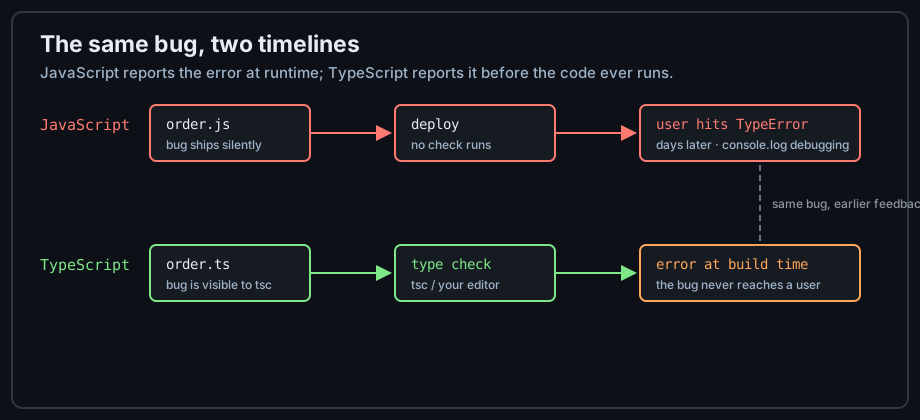
Consider a function every JavaScript developer has written in some form. The example below shows a classic bug: a typo in a property name that no tool can catch before the code runs.
Purpose of the example: demonstrate that the build (whatever bundles your JS) happily ships code that is guaranteed to crash.
// JavaScript: order.js — this file bundles and deploys without a single warning.
function orderTag(order) {
  // Bug: the property is `id`, but we typed `od` — a typo no tool notices.
  return `#${order.od}`;
}

// The bug is invisible until this line executes:
orderTag({ id: 7 }); // TypeError: Cannot read properties of undefined
What you should see: nothing at build time — the bundler ships it. The crash happens only when the function runs, with a stack trace that points at the symptom, not at the typo's origin.
Refactoring in the dark
The deeper cost is not the first bug — it is the second one. When you rename a field or change a function signature in JavaScript, the editor cannot tell you which call sites just broke, because there is no record anywhere of what shape your data has. You either grep and hope, or you find the breakage in tests — or worse, in production logs.
TypeScript's answer is to record those shapes once and let a checker verify every use. The same function, rewritten:
Purpose of the example: show the minimal TypeScript change — an annotation — and the guaranteed feedback it produces.
// TypeScript: order.ts
interface Order {          // a named shape: a contract for this data
  id: number;
}

function orderTag(order: Order): string {
  // `order.od` is now a compile error BEFORE the code ever runs:
  //   Property 'od' does not exist on type 'Order'. Did you mean 'id'?
  return `#${order.id}`;
}

orderTag({ id: 7 }); // "#7" — and the checker proved the property exists
What you should see: a red squiggle in the editor the moment you type order.od, and a hard error from tsc in CI if it slips through. The suggestion "Did you mean 'id'?" is possible because the checker knows the shape of Order.
What we learn: types are executable documentation plus a mechanical enforcer. The interface says what Order is; the checker makes sure every use agrees with that statement, forever, on every edit.
The failure pattern every JS developer knows
Scale the two examples up and you get the pattern that made TypeScript the default at Microsoft, Google, and most large Node shops:
- Shapes are implicit. What an object can contain lives only in the heads of the authors and in scattered usage.
- Change is risky. Any refactor must be validated by running everything, because nothing else validates it.
- The runtime is your test suite.
undefined is not a functionis discovered by execution — ideally in a test, realistically by a user.
TypeScript does not add runtime features JavaScript lacks. It adds a verification layer over the JavaScript you already write, so mistakes surface in step 2 of your workflow instead of step 3.
What TypeScript actually is (and is not)
Plenty of misconceptions cluster around TypeScript. Three clarifications prevent most of the confusion later in this track.
A superset, not a new language
TypeScript is JavaScript plus type syntax. Every valid JavaScript file is already valid TypeScript after trivial configuration. You do not learn a new language; you learn an annotation layer over the one you know. That is why this track is written for JavaScript developers, not Java or C# developers — your instincts transfer, the syntax is the only delta.
The compiler checks, the runtime stays JavaScript
TypeScript has no runtime of its own. The compiler (or a faster stand-in like esbuild) erases all types and emits plain JavaScript. Interfaces, generics, annotations — none of it exists when your code executes. This has two consequences you will verify on the compiler page:
- Zero runtime cost. The emitted JavaScript is what you would have written by hand.
- Types can lie about runtime. A type is a promise, not a guard — data from the network still needs validation at the boundary. We cover that honestly in the errors lesson.
What types add that JSDoc and editors cannot
A fair objection: "VS Code already guesses types, and JSDoc can annotate JavaScript." Both are true, and both are checkable with checkJs. What JSDoc cannot do well:
- Express composition. Mapped and conditional types (Phase 3) compute new types from old ones — JSDoc has no equivalent machinery.
- Scale. Large JSDoc annotations are harder to write and read than type syntax.
- Enforce architecture. Strict flags,
exactOptionalPropertyTypes, discriminated unions — these encode design decisions the checker then maintains for you.
JSDoc is a legitimate on-ramp (the migration lesson covers it); it is a limited destination.
Why the industry adopted it
TypeScript won because it attacks the three costs above directly, in a way that fit existing JavaScript ecosystems.
Scale: codebases outgrow memory
Below roughly ten thousand lines, a single developer holds the whole system in their head and dynamic typing costs little. Past that point — team growth, staff turnover, parallel features — the head-space model fails. Types become the shared, machine-checked memory of the project: the answer to "what does this return?" stops being "read the implementation" and becomes "read the type".
Dependencies with contracts
npm is JavaScript's superpower and its weakness. TypeScript's .d.ts declaration files give every dependency a typed API surface: your editor autocompletes real signatures, and upgrades that break your calls are flagged by the checker instead of by your users. The declarations lesson shows how this works under the hood.
Tooling that finally understands your code
With real types, editor features stop guessing: rename-symbol refactors across files, jump-to-definition that always lands correctly, and completion lists that only offer valid properties. These features are the day-to-day dividend — most TypeScript developers report the tooling, not the error messages, as the reason they never went back.
Contraexample: where plain JavaScript is fine
A case where annotations are overhead
An honest tutorial must show the boundary. TypeScript adds setup, a build step (or type-stripping runtime), and annotation maintenance. That price is not worth paying in every context:
Purpose of the example: a case where the annotation layer would be pure overhead.
// A throwaway script: 15 lines, used twice, never shipped to users.
const files = fs.readdirSync('.');
const sizes = files.map(f => fs.statSync(f).size);
console.log('total bytes:', sizes.reduce((a, b) => a + b, 0));
What you should see: a script that works immediately. Adding tsconfig.json, strict flags, and interfaces to this would not catch a meaningful class of bug — the domain is too small for the contract to be wrong in a way you would not notice.
The boundary condition
What we learn: the value of types grows with surface area and team size. Small scripts and one-off automation remain legitimate JavaScript territory. Production code, shared libraries, and anything with a second contributor are where TypeScript pays for itself — which is exactly where this track focuses.
Practice: test the motivation
These exercises check that you can articulate why before learning how. Everything in the rest of the track builds on this reasoning.
Predict the error
Without running it, state for each snippet whether the mistake is visible to a JavaScript bundler, only at runtime, or caught by TypeScript's checker:
// (a)
const user = { name: "Ada" };
console.log(user.nmae);

// (b)
function double(n) { return n * 2; }
double("4");

// (c)
interface Point { x: number; y: number }
const p: Point = { x: 1 };
console.log(p.y);
What you should see in your answer: (a) runtime — bundlers ship it, TypeScript catches it as "Property 'nmae' does not exist". (b) runtime — "4" * 2 is 8 via coercion, a silent wrong answer, the worst kind; TypeScript rejects passing a string where a number is declared. (c) compile time — missing y is flagged at the assignment. If you got (b)'s coercion twist wrong, notice that dynamic typing hides the bug inside valid semantics — the strongest argument of all.
Reading challenge
Open any JavaScript file you own and find one object whose shape you must remember rather than verify. Write the interface for it in a comment. That interface is your first TypeScript artifact — the setup lesson turns it into checked code.