
Metaprogramming & Macros
:(a + b) does not add anything — it returns a tree you can inspect, rewrite and evaluate later. A macro is an ordinary function that receives such a tree while your file is being parsed, and returns another tree in its place. Macros therefore run before your program runs, which is exactly why they can add syntax that no function call could express.
This lesson starts with the representation: how Julia stores a + b as an Expr, and how quoting and interpolation let you build one. From there you move to eval and world age, then to writing real macros — hygiene, escaping, and debugging with macroexpand. The last two chapters cover the patterns the ecosystem itself uses (@time, @inbounds, @generated) and the mistakes that make macro code unreadable.
Code as Data
To write macros you first need to see what the parser produces. Nothing about that representation is magic: expressions are instances of one struct, with a head symbol and a list of arguments, and they print back as the code you wrote.
Expr Objects
Every parsed construct that is not a literal becomes an Expr. Numbers, strings and symbols stay as themselves, which is why a tree is described as "atoms plus calls". dump shows the raw structure that Meta.show_sexpr prints in Lisp form.
# A literal is not an Expr — it is itself
typeof(1)                     # Int64
typeof(:x)                    # Symbol — a name, not a value

# A call is an Expr with head :call and three arguments
ex = :(x + 2 * y)
typeof(ex)                    # Expr
ex.head                       # :call — what kind of node this is
ex.args                       # Any[:+, :x, Expr(:call, :*, 2, :y)]

# The nested multiplication is its own Expr
ex.args[3].head               # :call
ex.args[3].args               # Any[:*, 2, :y]

# dump prints the same tree without the sugar
dump(ex)
#   Expr
#     head: Symbol call
#     args: Array{Any}((3,))
#       1: Symbol +
#       2: Symbol x
#       3: Expr
#         head: Symbol call
#         args: Array{Any}((3,))
#           1: Symbol *
#           2: Int64 2
#           3: Symbol y

# Several heads you will meet while rewriting trees
:(x = 1).head                # :(=)   assignment
:(a[i]).head                 # :ref   indexing
:(f(x)).head                 # :call  function call
:(x ? a : b).head            # :if    ternary lowers to a condition
:(function f() end).head     # :function
:(struct P end).head         # :struct
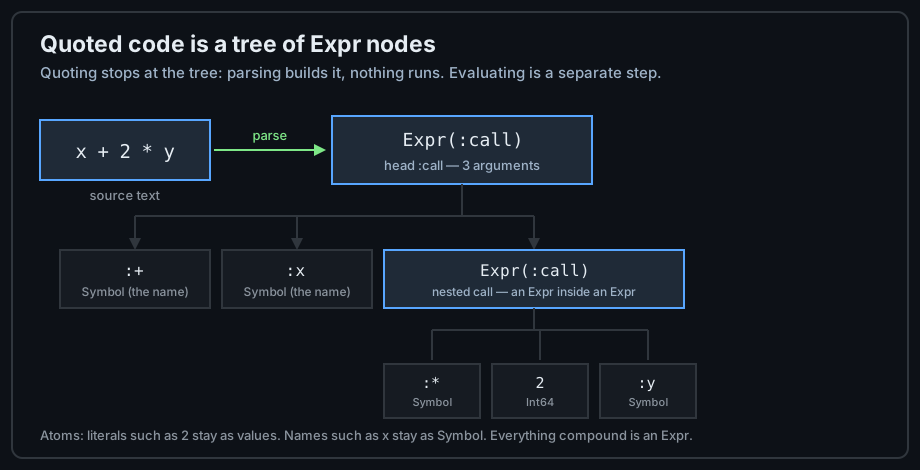
eval turns a tree back into a result.Because the tree is data, you can walk it with recursion and answer structural questions: is this node a call, what is the function name, how many arguments does it take. Tooling built on that ability is what makes features such as automatic differentiation and domain-specific languages possible in Julia.
Quoting and Interpolation
A colon in front of an expression quotes it: the parser builds the tree and hands it back instead of evaluating it. Inside a quoted block, $ splices a value or another expression back in, which is how you turn a template into a concrete tree.
# Quote: build the tree, do not run it
q = :(2 + 3)                  # Expr(:call, :+, 2, 3)
eval(q)                       # 5 — evaluation is a separate step

# Quote a block with begin ... end
block = quote
    a = 1
    b = 2
    a + b
end
block.head                    # :block

# Interpolation splices a value in as a literal
n = 7
:(x + $n)                     # Expr(:call, :+, :x, 7)

# Interpolation can also splice a whole subtree
term = :(2 * y)
:(x + $term)                  # Expr(:call, :+, :x, Expr(:call, :*, 2, :y))

# Without interpolation you get the symbol, not the value
:(x + n)                      # Expr(:call, :+, :x, :n)

# Interpolating a symbol is how templates build names
name = :total
f = :(function $(name)() 0 end)   # defines a function called total

# Build symbols at runtime for generated names
Symbol("a", "b")              # :ab — the function form
Symbol("counter_", 1)         # :counter_1
The distinction between :n and $n is the single most important detail of metaprogramming: the first is a name in the generated code, the second is the current value of a variable in your program. Mixing them up produces code that compiles and then fails for reasons that look impossible.
Inspecting and Rewriting a Tree
A macro is a rewrite rule. Writing one by hand therefore means: pattern-match on head and args, build a replacement, and return it. The next example is a complete, useful rewrite — a function that collects every called name in an expression.
# Collect every function name called inside an expression
function called_names(ex)
    names = Symbol[]
    walk(e) = begin
        if e isa Expr
            if e.head === :call && e.args[1] isa Symbol
                push!(names, e.args[1])       # the callee's name
            end
            foreach(walk, e.args)             # recurse into every argument
        end
    end
    walk(ex)
    unique(names)
end

called_names(:(f(g(x)) + h(y)))     # [:f, :g, :h]
called_names(:(sin(x) + cos(y)))    # [:sin, :cos]

# Replacing a subtree: turn every `+` into a call to `myadd`
function rename_calls(ex, from::Symbol, to::Symbol)
    ex isa Expr || return ex                  # atoms are returned unchanged
    args = map(a -> rename_calls(a, from, to), ex.args)
    ex.head === :call && ex.args[1] === from && return Expr(:call, to, args...)
    Expr(ex.head, args...)
end

rename_calls(:(a + b + c), :+, :myadd)
# :(myadd(myadd(a, b), c))

# Structural predicates from Base.Meta keep the intent readable
using Base.Meta: isexpr
isexpr(:(f(x)), :call)              # true

# Dot access and subscripts survive quoting — they are just Expr heads
:(a.b).head                         # :.
:(a[i]).head                        # :ref
Two habits keep tree code honest: always handle the atom case first, and always reconstruct with Expr(head, args...) rather than mutating shared nodes. Trees built by quoting are ordinary mutable objects, and mutating one that other code still references produces bugs that surface in unrelated places.
Evaluating Code
Building a tree achieves nothing until something runs it. eval does that in a module of your choice, but it comes with a rule about time — world age — that explains most surprises people hit when they first use it.
eval and Scope
eval always evaluates in a module, and by default that is the module where the call is written. Understanding that is what lets you define functions in Main from a helper module, or evaluate an expression inside your own namespace without leaking into the caller's.
# eval runs a tree in the current module
eval(:(a = 10))
a                             # 10 — the assignment happened here

# Explicit module target: define something in Main from anywhere
eval(Main, :(greet() = "hello"))
greet()                       # "hello"

# A tree can come from a string — dynamic code from a configuration file
src = "f(x) = x^2"
eval(Meta.parse(src))
f(5)                          # 25

# Parsing is explicit; there is no implicit eval of strings
Meta.parse("1 + 1")           # :(1 + 1) — still a tree

# And a tree can be passed around before it is evaluated
make_adder(n) = :(x -> x + $n)
add3 = eval(make_adder(3))    # a closure built from a template
add3(10)                      # 13

# Code that returns code is the normal shape of a small DSL
macro define_accessors(name)
    field = QuoteNode(name)
    quote
        $(esc(Symbol("get_", name)))() = $(esc(name))
        $(esc(Symbol("set_", name)))(v) = ($(esc(name)) = v)
    end
end
Prefer passing a module explicitly when the helper is reusable. Code that calls bare eval inside Main is nearly impossible to move into a package later, because every name it created lived in the wrong namespace.
World Age
Julia distinguishes the world where code is being compiled from the world where it is running. A method defined by eval during a call belongs to a newer world, and the call already being executed cannot see it — that is the MethodError known as a world-age error.
# This pattern fails: the method is defined after the call was compiled
function define_late()
    eval(:(late() = 42))
    return late()          # ERROR: MethodError — late is not visible yet
end

# Fix 1: finish defining, then call from a fresh top-level call
function define_now()
    eval(:(late() = 42))
    return nothing
end
define_now()
late()                     # 42 — a new top-level call sees the newest world

# Fix 2: Base.invokelatest runs immediately in the newest world (slower)
function define_and_call()
    eval(:(late2() = 7))
    return Base.invokelatest(late2)
end
define_and_call()          # 7

# Macros never hit world age: they run at parse time, before compilation
macro double(x)
    return :(2 * $(esc(x)))
end
@double 21                 # 42 — expanded, then compiled as one unit

# Rule of thumb
#   top level or include → eval is fine
#   inside a function    → define with eval and call from the caller,
#                          or use invokelatest
World age is the reason metaprogramming in Julia is written with macros far more often than with eval. A macro's output becomes part of the enclosing function and is compiled with everything else, so the timing question never arises.
Macro Expansion
Before writing macros, learn to read expansion. @macroexpand shows what a macro call turns into without running it, and the function form macroexpand does the same for a tree you built in code.
# See what a macro produces, without evaluating it
@macroexpand @time 1 + 1
# quote
#     local t0 = time_ns()
#     local val = 1 + 1
#     local t1 = time_ns()
#     ...
# end

# Expansion of one of your own macros
macro twice(x)
    return :($(esc(x)) + $(esc(x)))
end
@macroexpand @twice a          # :(a + a)

# The programmatic form works on a tree
ex = macroexpand(Main, :(@twice b))
ex                             # :(b + b)

# Expansion is recursive by default: nested macros are already gone
macro first_probe(x) :(second_probe) end
macro second_probe()
    :("probe")
end
macroexpand(Main, :(@first_probe 1))    # "probe"
When a macro behaves unexpectedly, expansion is your debugger: run @macroexpand, compare the printed tree with what you intended, and the mistake is usually visible in one screen. The next chapter puts that loop to work while writing macros from scratch.
Writing Macros
A macro is a function in a special calling convention: it receives the unevaluated argument trees and must return a tree. That is the whole contract, and it is what makes macros both powerful and easy to misuse.
Defining a Macro
Define with macro, call with @. Arguments arrive as Expr or literal values, never evaluated, and the value you return is what the call site becomes.
# The simplest useful macro: repeat an expression n times
macro repeat_n(n, x)
    return quote
        for _ in 1:$(esc(n))          # esc: use the CALLER's n
            $(esc(x))                 # esc: use the CALLER's x
        end
    end
end

count = 0
@repeat_n 3 (count += 1)              # runs the block three times
count                                 # 3

# Arguments really are trees — inspect before rewriting
macro show_tree(x)
    @info "received" expression = x typeof = typeof(x)    # runs at COMPILE time
    return esc(x)
end
@show_tree 1 + 2                      # info printed while compiling; result 3

# A macro can take any number of arguments and can accept a block
macro labelled(label, body)
    return quote
        println($(esc(label)), ": ", $(esc(body)))
    end
end

@labelled "answer" (6 * 7)            # prints "answer: 42"

# The do-block form passes the block as the first argument
macro run_twice(body)
    return quote
        $(esc(body))
        $(esc(body))
    end
end

@run_twice begin
    println("hello")
end

# Macros do NOT dispatch on types: everything is a tree
macro kind_of(x)
    return QuoteNode(typeof(x))       # baked in as a literal value
end
@kind_of 1 + 1                        # Expr (:call)
@kind_of "text"                       # String
Two consequences follow from the contract. First, a macro that returns a value instead of a tree produces a confusing TypeError at the call site; second, because macro arguments are not evaluated, a macro can accept syntax that would be a syntax error in a function — a block, an assignment, or an unbound name.
Hygiene and esc
Macros are hygienic: names a macro introduces are renamed so they cannot collide with the caller's variables. When the macro is supposed to use a caller variable, you say so explicitly with esc.
# Hygiene: the macro's own `tmp` cannot clash with the caller's tmp
macro hygienic_sum(x)
    return quote
        tmp = $(esc(x))               # tmp belongs to the macro
        tmp + tmp
    end
end

tmp = 100
@hygienic_sum 5                       # 10 — the caller's tmp is untouched
tmp                                   # 100

# What the rename looks like: a gensym'd symbol
macro show_gensym()
    quote
        local y = 1
    end
end
@macroexpand @show_gensym()           # contains a name like ##y#251

# The macro cannot see the caller's variable without esc
macro bad_double(x)
    return :(2 * x)                   # ERROR: x is undefined at the call site
end
# @bad_double n                       # UndefVarError: x

# Fix: escape the caller's expression
macro good_double(x)
    return :(2 * $(esc(x)))
end
n = 21
@good_double n                        # 42

# Escape the whole block when the macro is a template around user code
macro timeit(body)
    return quote
        local t0 = time_ns()
        local val = $(esc(body))      # user code keeps the caller's scope
        local t1 = time_ns()
        println("elapsed ms: ", (t1 - t0) / 1e6)
        val
    end
end

@timeit sum(1:1_000_000)              # prints a time, returns the sum

# gensym builds a guaranteed-unique name by hand when needed
macro counter()
    local name = gensym(:counter)
    return quote
        $name = get($(esc(:dict)), "k", 0)   # escaped: caller's dict
    end
end
The rule to remember: escape the caller's expressions, and never escape the macro's own temporaries. Escaping too much reintroduces collisions; escaping too little produces UndefVarError for names the caller expected to work.
Debugging a Macro
Macro errors surface at compile time, often far from the call, so the workflow is: expand, read, fix. Keeping the tree-building logic in ordinary functions makes the tree testable without ever compiling a macro.
# Expand one level at a time while developing
@macroexpand1 @repeat_n 3 (count += 1)      # shows only this macro's output
@macroexpand @repeat_n 3 (count += 1)       # shows the fully expanded result

# Put the rewriting in a plain function: it can be unit tested
build_double(x) = :(2 * $(esc(x)))

macro good_double(x)
    return build_double(x)
end

# Test the builder directly — no macro involved
build_double(:n)                             # :(2 * n)

# Print and return: a throwaway probe while writing a macro
macro probe(x)
    println("probe got: ", x)                # compile-time output
    return esc(x)
end
@probe 1 + 1                                 # prints "probe got: 1 + 1", yields 2

# A helper that dumps a tree to a file is easier to read than long prints
dump_tree(ex) = open("tree.txt", "w") do io
    show(io, MIME("text/plain"), ex)
end

# Common failure: returning a non-Expr from a macro
macro oops(x)
    return 42                                # ERROR: invalid macro result
end
# @oops 1                                  # expected Expr, got Int64

# Common failure: unbalanced escaping shows as a giant expansion
macro noisy(x)
    return quote
        $(esc(x)) + $(esc(x)) + $(esc(x))
    end
end
@macroexpand @noisy a + b                    # :(a + b + a + b + a + b)
Two symptoms identify most macro bugs immediately: an expansion that references a name you never wrote means you forgot esc, and an expansion that looks correct but fails with UndefVarError means the macro's own temporary escaped. Reading @macroexpand tells you which one you have.
Macro Patterns
Real macros fall into a handful of shapes. Recognising them lets you copy a proven design instead of inventing one — and, just as usefully, lets you see when a macro is not needed at all.
Validation Macros
The most common macro is shorthand for a check that should disappear in production. @assert is the built-in version; writing your own shows how a message, a condition, and a level are baked into the call site.
# Assert with a message and the offending value shown
macro check(cond)
    return quote
        if !($(esc(cond)))
            throw(ArgumentError("check failed: " * $(string(cond))))
        end
        nothing
    end
end

function ratio(a, b)
    @check b != 0
    return a / b
end

ratio(6, 3)                  # 2.0
# ratio(6, 0)               # ArgumentError: check failed: b != 0

# The condition's TEXT is baked in at compile time — that is a macro's advantage
macro check2(cond, msg)
    return quote
        $(esc(cond)) || throw(ArgumentError($(esc(msg)) * " (" * $(string(cond)) * ")"))
    end
end

# Guard-clause macro used at the top of functions
macro require(cond)
    quote
        $(esc(cond)) || error("precondition failed")
    end
end

f(x) = (@require x > 0; sqrt(x))
# f(-1)                      # ErrorException: precondition failed

# A macro that validates its own ARGUMENTS at compile time catches typos early
macro enum_def(name, values)
    values isa Expr || error("expected a tuple of symbols")
    syms = values.args
    ex = Expr(:block)
    for s in syms
        push!(ex.args, :(const $(esc(s)) = $(QuoteNode(s))))
    end
    return ex
end

@enum_def Color (red, green, blue)
red                          # :red — already a constant, no runtime cost
Validation macros earn their place because they capture information no function can: the source text of the condition. That text is available only at expansion time, which is precisely why @assert is a macro rather than a function.
Unrolling and Scope Macros
The second family generates repetitive code from a compact description — unrolled loops, per-field initialisers, or a batch of small accessor functions. The value comes from code that is tedious rather than conceptually hard.
# Unroll a fixed-length loop at expansion time
macro unroll(n, body)
    n isa Int || return :(error("unroll needs an integer literal"))
    ex = Expr(:block)
    for i in 1:n
        push!(ex.args, :($(esc(body))($i)))     # body is a function of i
    end
    return ex
end

trace = Int[]
emit(i) = push!(trace, i)
@unroll 4 emit
trace                                        # [1, 2, 3, 4] — no loop at runtime

# Define several variables in the CALLER's scope using esc on the names
macro defvars(names...)
    ex = Expr(:block)
    for name in names
        push!(ex.args, :(($(esc(name)) = 0)))
    end
    return ex
end

@defvars a b c
(a, b, c)                                    # (0, 0, 0)

# Per-field accessors: a real pattern for struct-heavy code
macro accessors(T, fields...)
    T = esc(T)
    ex = Expr(:block)
    for f in fields
        fname = QuoteNode(f)
        getter = esc(Symbol("get_", f))
        setter = esc(Symbol("set_", f))
        push!(ex.args, :($getter(x) = getfield(x, $fname)))
        push!(ex.args, :($setter(x, v) = setfield!(x, $fname, v)))
    end
    return ex
end

mutable struct Person
    name::String
    age::Int
end

@accessors Person name age
p = Person("Ana", 30)
get_name(p)                                  # "Ana"
set_age(p, 31)
p.age                                        # 31

# The generated code is ordinary code — @code_lowered shows the unrolled block
@code_lowered trace
Unrolling only pays when the count is known at parse time, which is exactly what a literal argument guarantees. Keep such macros small: a generated function offers the same idea with the type system behind it, and it is usually easier to reason about.
Generated Functions
A @generated function runs its body once at compile time, sees the argument types, and returns the code to use for those types. It is metaprogramming inside the type system: no eval, no world age, and the result is fully specialised.
# Sum any tuple: the compiler sees the length and emits a straight sum
@generated function tsum(t::Tuple)
    exprs = [:(getfield(t, $i)) for i in 1:fieldcount(t)]   # no loop survives
    return Expr(:call, :+, exprs...)
end

tsum((1, 2, 3))                # 6
tsum((1.5, 2.5))               # 4.0
@code_lowered tsum((1, 2))     # the body is just 1 + 2 — nothing to unroll

# The body runs at COMPILE time and must return a tree
@generated function describe(x)
    return QuoteNode(typeof(x))     # baked in as a literal
end

describe(1)                    # Int64
describe("s")                  # String

# Rules: read only the TYPES, never the values; never mutate global state;
# never call a function defined after the generated body runs.
@generated function firstdim(x::AbstractArray{T}) where {T}
    # T is available here; the array's contents are NOT
    return :(size(x, 1))
end

firstdim(rand(3, 4))           # 3

# A generated function can also inspect its own type parameters
@generated function zero_like(x::AbstractArray{T,N}) where {T,N}
    return Expr(:call, :zeros, T, :(size(x)))
end

zero_like([1, 2, 3])           # [0, 0, 0]
Generated functions are the right tool when behaviour depends on the types of the arguments in ways that recursion cannot express — tuples of unknown length, dimensional arrays, or type-parameter-driven loops. For anything that depends on values, an ordinary function with a branch is clearer and just as fast.
Macros in the Ecosystem
Julia's standard library and its scientific packages expose much of their functionality as macros. Knowing which family you are calling tells you what the macro can do that a function cannot.
The Standard Library
Measurement, logging, and introspection macros all rely on the same trick: the call site's text and the surrounding scope are available at expansion time, so the report can name what it measured.
# Measurement macros report the source expression, not a value
@time sum(1:1_000_000)        # prints time and allocation info
@elapsed sum(1:1_000_000)     # returns seconds only
@allocated rand(1000)         # returns bytes allocated

# @show prints the code AND the value — impossible for a function
x = 6 * 7
@show x                       # x = 42

# Logging macros capture module and location automatically
@info "worker started" id = 3      # structured key = value pairs
@warn "retrying" attempt = 2
@debug "cache hit" key = "a"

# Introspection macros inspect the method being compiled
f(v) = sum(v)
@code_warntype f([1, 2, 3])   # shows inferred types for this call
@code_native f([1])           # shows generated machine code

# Performance annotations are macros because they must attach to a scope,
# not to a value
fast_sum(v) = @inbounds @simd for i in eachindex(v)
    total += v[i]
end
Notice that every one of these needs something a function call cannot provide: the argument's source text, the enclosing module, or a whole loop body. That is the test for whether a macro is justified.
Domain-Specific Languages
Packages such as JuMP and Turing use macros to let you write mathematics or probabilistic models directly, then translate the tree into solver or sampler calls. The macro is the parser of a small language embedded in Julia.
# Sketch of how a modelling DSL reads — JuMP syntax
using JuMP
model = Model()
@variable(model, x >= 0)              # declares a decision variable
@variable(model, y >= 0)
@constraint(model, 2x + y <= 10)      # constraints look like mathematics
@objective(model, Max, 3x + 2y)       # the objective is written literally

# What makes this a macro and not a function call:
#   - `2x` (implicit multiplication) is not valid function syntax
#   - names are introduced into the model, not into a value
#   - the tree is inspected to find variables and coefficients

# The same technique powers unit libraries
using Unitful
@u_str 9.81                       # 9.81 m s^-2 — string macro
1.0u"m/s" * 2.0u"s"               # 2.0 m — dimensions tracked in the type

# String macros are just macros whose name starts with @ and ends with _str
macro json_str(s)
    return Meta.parse(s)          # a string literal becomes a Julia value
end
@json_str "{"a": 1}"              # Expr(:call, :(:), ...) — parsed at compile time
Because the DSL's input is a tree, the package can report errors in terms of your mathematical notation instead of its own internals. That readability is the entire value of the macro layer — when a DSL's diagnostics are worse than plain function calls, the DSL has overreached.
Performance and Loop Macros
Several macros exist purely to hand facts to the compiler that it cannot prove. They are the bridge between metaprogramming and the performance chapter that follows.
# Promise the compiler that indices are in range — removes bounds checks
function dot_prod(a, b)
    s = 0.0
    @inbounds for i in eachindex(a, b)
        s += a[i] * b[i]              # no per-access bound test
    end
    s
end

# @simd allows reordering of the loop, enabling vector instructions
function scale!(v, k)
    @simd for i in eachindex(v)
        v[i] *= k
    end
    v
end

# @views turns slicing into views instead of copies
function row_sums(M)
    totals = zeros(size(M, 1))
    for i in axes(M, 1)
        totals[i] = sum(@view M[i, :])    # no allocation per row
    end
    totals
end

# @threads and @spawn are macros for the same reason: they wrap a scope
using Base.Threads
function par_sum(v)
    partials = zeros(nthreads())
    @threads for i in eachindex(v)
        partials[threadid()] += v[i]      # per-thread accumulator
    end
    sum(partials)
end

# The contract of these macros is a promise. Break it and you get
# wrong answers or a crash — never a friendly error.
#   @inbounds with an out-of-range index → memory corruption
#   @simd on a loop with carried dependencies → wrong result
#   @threads writing one shared counter → a data race
Treat each of these as a promise to the compiler, not as an optimisation switch. Only use them when you can prove the condition holds — typically inside a function whose bounds you have already validated, and with a benchmark that shows the gain.
Common Pitfalls
Metaprogramming failures have a small set of causes. Each one is cheap to avoid once you know the shape of the mistake.
eval in a Hot Loop
eval is not a normal call: it compiles new code, invalidates caches, and runs in a fresh world. Calling it per iteration turns a millisecond task into a minute-long one, and it leaks definitions into a module that never gets cleaned.
# Bad: recompiles a new method for every value in the range
function slow_table(n)
    results = Any[]
    for i in 1:n
        eval(:(table_entry_$i() = $i))       # one new method per iteration
        push!(results, Core.eval(Main, Symbol("table_entry_$i"))())
    end
    results
end

# Good: build the value, or build one function that takes the index
fast_table(n) = collect(1:n)

fast_table(5)                    # [1, 2, 3, 4, 5]

# When code generation really is needed, generate it ONCE at load time
const TABLE = Dict{Symbol, Function}()
function build_table!(names)
    for (i, name) in enumerate(names)
        eval(:(const $(name) = $i))           # one definition per name, at load time
    end
    nothing
end

# Or compute a value instead of defining a method
lookup(dict, key) = get(dict, key, 0)
lookup(Dict("a" => 1), "a")      # 1
The practical rule: eval belongs at load time or in a REPL helper, never in a loop, and never inside a function that runs per request. If you need per-value behaviour, put the value in a dictionary or pass it as an argument.
Over- and Under-Escaping
Hygiene keeps macro internals private, and esc deliberately breaks that privacy for the caller's names. Getting the balance wrong produces two opposite bugs — and both look like ordinary UndefVarError messages.
# UNDER-escaped: the macro body refers to names the caller cannot see
macro evens_bad(v)
    return :(filter(isequal(0), v .% 2))       # v and .% are macro-local
end
# nums = [1, 2, 3]
# @evens_bad nums                            # UndefVarError: v not defined

# FIXED: escape the caller's expression
macro evens_ok(v)
    return :(filter(isequal(0), $(esc(v)) .% 2))
end
nums = [1, 2, 3]
@evens_ok nums                               # [2]

# OVER-escaped: the macro's own temporary leaks into the caller's scope
macro sum_all_bad(v)
    return esc(quote
        total = 0                            # ESCAPED: collides with the caller's total
        for x in $v
            total += x
        end
        total
    end)
end

total = "important"
@sum_all_bad [1, 2, 3]                       # overwrites the caller's total
total                                        # 6 — the string is gone

# FIXED: escape only the caller's expression, keep the internal name private
macro sum_all_ok(v)
    return quote
        total = 0                            # hygienic: renamed by the compiler
        for x in $(esc(v))
            total += x
        end
        total
    end
end

total = "important"
@sum_all_ok [1, 2, 3]                        # 6
total                                        # "important" — untouched

# When in doubt, expand and look for the gensym names
@macroexpand @sum_all_ok [1, 2, 3]           # contains ##total#NNN
Review macro code with one question per name: whose scope should this live in? The caller's expressions get esc; the macro's own variables and helper names do not.
When a Function Is Enough
Macros cost readability, stack traces, and tooling support. If a function can express the same thing — because nothing needs the argument's text or the caller's scope — the function is the better engineering choice every time.
# Macro, unnecessary: the arguments are evaluated anyway
macro add_bad(a, b)
    return :($(esc(a)) + $(esc(b)))
end
@add_bad 1 2                  # 3 — a function call would do exactly this

add_good(a, b) = a + b
add_good(1, 2)                # 3 — debuggable, composable, typed

# Pass a FUNCTION when only the operation varies
apply_twice(f, x) = f(f(x))
apply_twice(x -> x + 1, 0)    # 2 — no macro needed

# Maybe a macro IS justified: it needs the text of the argument
macro describe_nicely(x)
    return :(string($(esc(x)), " — value of: ", $(string(x))))
end
@describe_nicely 2 + 2        # "4 — value of: 2 + 2"

# Or it must control evaluation (short-circuit, repetition, scope entry)
macro unless(cond, body)
    return :(if !($(esc(cond))); $(esc(body)); end)
end
@unless false (println("ran"))    # prints

# A last resort test: does the macro body need `esc`, `string(arg)`,
# `typeof(arg)` on the TREE, or an unevaluated block?
# If none of those, write a function.
Julia's ecosystem follows this rule closely: dispatch, higher-order functions, and types solve most problems, so macros cluster in the three places only macros can reach — logging, measurement, and syntax for a domain language.
:( )) turns code into an Expr tree of heads and arguments, with $ to splice values and sub-expressions. Walk and rebuild trees with ordinary recursion, and never mutate a tree you did not create. eval runs a tree in a module, subject to world age: define at load time, and use Base.invokelatest only when you must call immediately. Macros are functions from trees to trees that run at parse time — they are the idiomatic tool, and @macroexpand is their debugger. Escape the caller's expressions with esc and leave your own temporaries hygienic; @generated functions do the same job driven by argument types. Reach for a macro only when you need the argument's text, its scope, or an unevaluated block.
Macros are also how the compiler receives promises it cannot verify on its own — @inbounds, @simd, @threads. Next: Performance & Benchmarking shows how to measure whether those promises actually bought you anything.